Federal Circuit Affirms Government-Contractor Immunity in Patent Suit Over NASA’s Ingenuity Helicopter

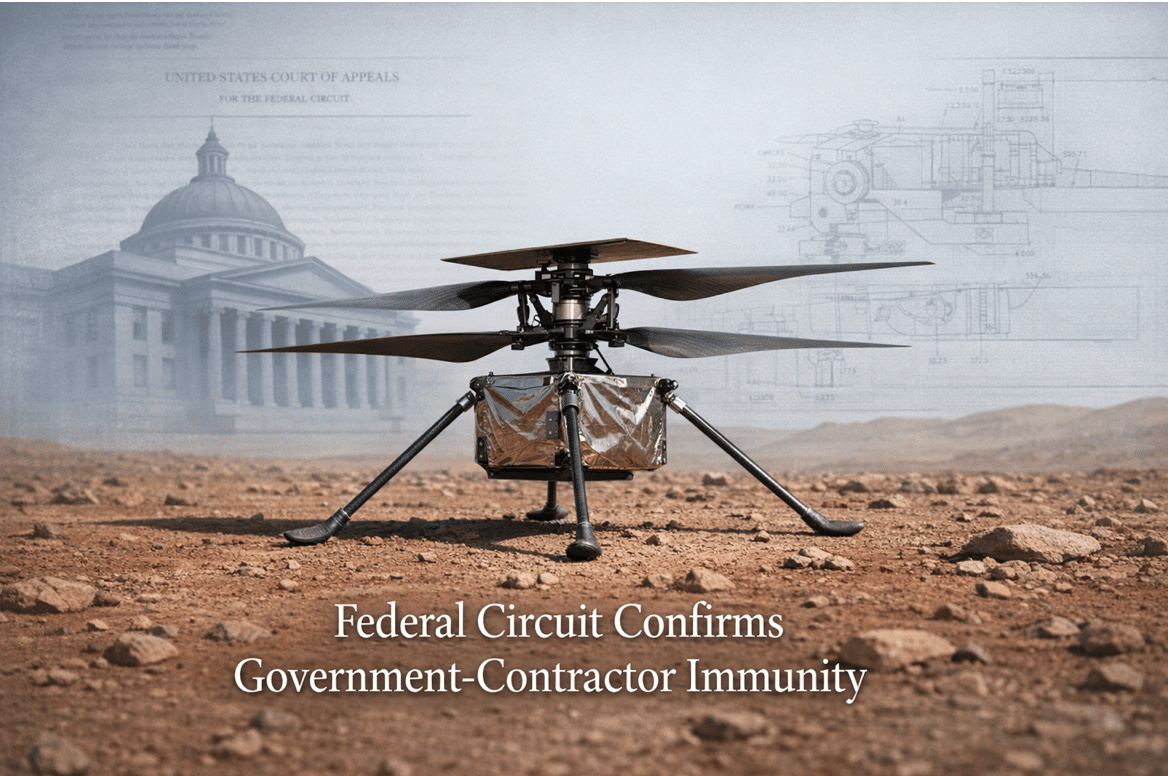
In a decision with practical significance for government contractors, subcontractors, and patent owners, the U.S. Court of Appeals for the Federal Circuit affirmed summary judgment for AeroVironment in a patent case involving NASA’s Ingenuity Mars helicopter. The court held that 28 U.S.C. § 1498 barred the claims against AeroVironment because the accused work was performed for the federal government and with the government’s authorization or consent. The court also affirmed the denial of attorneys’ fees.
Background
Paul and David Arlton are named inventors and co-owners of U.S. Patent No. 8,042,763, which covers a rotary-wing vehicle with an elongated tubular backbone and a counter-rotating coaxial rotor system. They licensed the patent to Lite Machines Corporation, a company that developed unmanned aerial vehicles.
Beginning in 2005, Lite Machines received Small Business Innovation Research (SBIR) and Small Business Technology Transfer (STTR) awards from U.S. defense agencies. Those programs are designed to help small businesses develop and commercialize technology.
In 2013, AeroVironment became a subcontractor to NASA’s Jet Propulsion Laboratory (JPL), a federally funded research center managed by Caltech under contract with NASA. The subcontract called for AeroVironment to build a helicopter for JPL to provide to NASA for use on Mars.
AeroVironment and JPL developed Ingenuity, the small autonomous helicopter later flown on Mars. In 2020, the Arltons sued AeroVironment in district court, alleging that Ingenuity infringed the ’763 patent.
AeroVironment responded that § 1498 barred the claims against it. That statute channels certain patent claims involving government use away from private contractors and toward an action against the United States in the Court of Federal Claims.
The Arltons argued that the government should have awarded a Phase III SBIR/STTR contract to Lite Machines, not AeroVironment, and therefore could not validly authorize or consent to AeroVironment’s alleged infringement.
The case took an unusual turn in 2021, when a terrestrial version of Ingenuity called “Terry” appeared on 60 Minutes. The district court reopened discovery so the Arltons could explore whether AeroVironment had made commercial use of Terry outside the government project.
After additional discovery, the district court again granted summary judgment for AeroVironment in August 2023. It found that the Terry demonstrations were de minimis, meaning too minor to create liability against a private party in district court. The court also denied AeroVironment’s request for attorneys’ fees under 35 U.S.C. § 285. Both sides appealed.
What the Federal Circuit decided
Summary judgment affirmed. The Federal Circuit agreed that § 1498 applied. In general, that statute requires patent claims based on use “by or for the United States” to be brought against the United States in the Court of Federal Claims, rather than against a contractor in district court.
Terry demonstrations did not alter the result. The court held that AeroVironment’s public displays of the terrestrial helicopter “Terry” did not defeat immunity. The record supported the view that those uses remained tied to government work and were too limited to create private-party liability.
Attorneys’ fees denied. The Federal Circuit also upheld the denial of fees under 35 U.S.C. § 285, concluding that the case was not sufficiently exceptional to justify fee shifting.
Court’s reasoning
The court first rejected the argument that alleged errors in the SBIR/STTR contracting process prevented the government from authorizing AeroVironment’s work. Even if Lite Machines believed it should have received a Phase III award, the court viewed that issue as distinct from the § 1498 question. In the court’s view, a dispute over contract award rights belongs in a contract protest, not in a patent suit against a contractor.
Second, the record supported the conclusion that AeroVironment’s accused work was done for the government and with government authorization or consent. The subcontract documents tied the work directly to JPL’s NASA prime contract.
The court also held that the Terry evidence did not change the outcome. Prior decisions recognize that limited display activity, without meaningful commercial exploitation, does not necessarily remove § 1498 protection. On this record, the demonstrations were too minor to support district-court liability against AeroVironment.
Finally, on fees, the court deferred to the district court’s assessment that the plaintiffs’ position, although unsuccessful, was not frivolous or brought in bad faith.
What companies should do now
For government contractors and subcontractors, the decision underscores the importance of a clear documentary record. Prime contracts, subcontracts, statements of work, and related authorization language should show that the accused activity was undertaken for the government and within the scope of government direction.
Companies should also separate government performance from commercial promotion wherever possible. Limited demonstrations tied to government work may remain protected, but broader commercial use can create additional risk. That issue should be reviewed before conference displays, media appearances, investor materials, or product marketing involving technology developed under a government program.
For patent owners, the case is a reminder to assess forum and immunity issues at the outset. If the alleged infringement arises from use by or for the United States, a district-court action against the contractor may not be the right path. Contract-award disputes and patent-infringement claims raise different questions and may require different remedies.
As a practical matter, companies should document government authorization and consent, preserve records showing the work was performed for the government, review public-facing uses of government-developed technology, and evaluate immunity and forum issues early in any dispute.