Eleventh Circuit Affirms DISH Copyright Win Over Unauthorized Arabic-Language Streaming Services

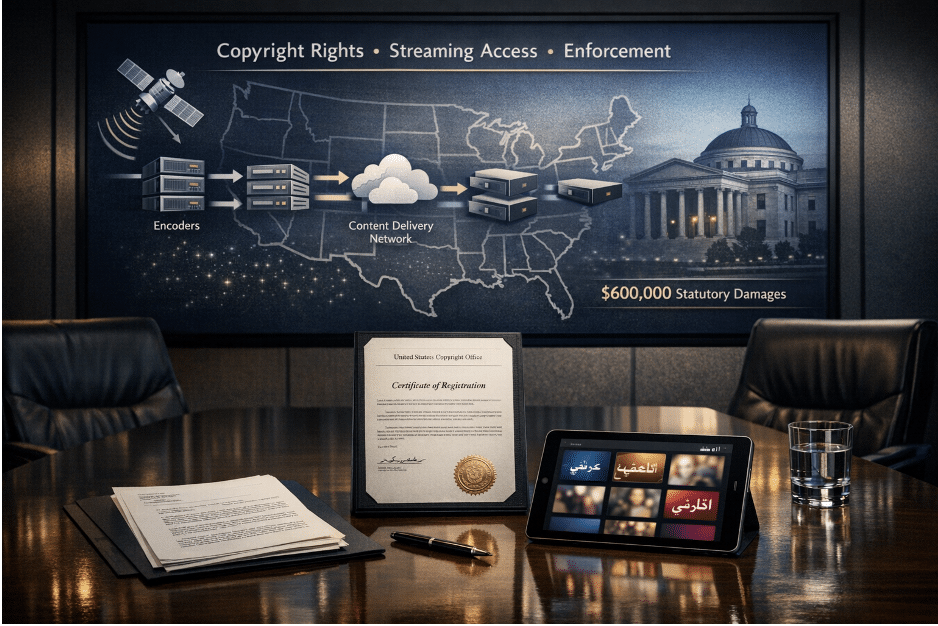
The U.S. Court of Appeals for the Eleventh Circuit affirmed a copyright judgment for DISH Network L.L.C. in a dispute over unauthorized internet retransmission of Arabic-language television programming. The decision reinforces a practical point for media, streaming, and content-distribution companies: exclusive distribution rights remain enforceable when protected content is captured, encoded, and delivered to U.S. customers through internet-based services.
Background
DISH holds exclusive U.S. rights to distribute and publicly perform certain Arabic-language programming carried on 21 channels. The appeal focused on DISH’s agreements with MBC FZ LLC, a United Arab Emirates media company that provided five of those channels.
In June 2016, MBC registered four audiovisual works with the U.S. Copyright Office. Copyright registration is important because it can create a presumption that the registered work is valid and owned by the registrant, subject to challenge.
The defendants, Gaby Fraifer, Tele-Center, Inc., and Planet Telecom, Inc., operated services including UlaiTV and AhlaiTV. According to the court, those services allowed U.S. customers to watch DISH’s protected Arabic-language channels through set-top boxes without DISH’s permission and without paying DISH.
The alleged transmission process had two key technical components. The defendants used encoders to convert programming into a format suitable for streaming. They also used content delivery networks, or CDNs, which are distributed servers that move online content closer to end users to improve streaming reliability.
DISH sued in 2016 in the U.S. District Court for the Middle District of Florida. The district court granted DISH summary judgment on ownership issues, held a bench trial on infringement, entered a permanent injunction, and awarded $600,000 in statutory damages, plus attorney fees and costs.
What the Court Decided
The Eleventh Circuit affirmed the district court’s judgment in full. The court rejected the defendants’ challenges to DISH’s copyright ownership, the transfer of rights from MBC to DISH, the infringement finding, and several trial rulings.
The court reviewed legal conclusions de novo, meaning it considered those issues fresh without deferring to the district court. It reviewed factual findings for clear error, a deferential standard that asks whether the trial court made a definite and firm mistake.
- Affirmed ownership ruling: DISH established that MBC owned the registered works and that the relevant rights were transferred to DISH.
- Affirmed infringement ruling: The evidence supported a finding that the defendants directly infringed DISH’s exclusive rights through the use of encoders.
- Affirmed remedies: The permanent injunction, $600,000 statutory damages award, attorney fees, and costs remained intact.
Court’s Reasoning
- DISH could rely on MBC’s copyright registrations. The defendants argued that DISH had not proven valid ownership of the works. The Eleventh Circuit disagreed. Applying UAE law, the court concluded that the works were properly treated as collective works and that MBC’s registrations supported ownership.
- The transfer from MBC to DISH was sufficient for enforcement. The court found no basis to disturb the district court’s conclusion that DISH held exclusive U.S. distribution and public-performance rights. Public performance means showing or transmitting a copyrighted work to the public, including by digital transmission.
- The encoder evidence was enough to prove direct infringement. Direct infringement occurs when a party violates one of the copyright owner’s exclusive rights without authorization. The Eleventh Circuit held that the defendants’ operation of encoders independently supported the infringement finding, so it did not need to decide whether the CDN theory also supported liability.
- The district court’s fact finding was not clearly erroneous. The defendants argued that PayPal and WHOIS records did not prove they operated encoders located in Germany and Tampa, Florida. The Eleventh Circuit looked at the total record and found no clear error in the district court’s finding that the defendants operated the encoders.
Practical Implications for Content and Streaming Companies
The decision is a useful reminder that copyright enforcement does not stop at the edge of traditional broadcasting. A company that holds exclusive distribution rights may be able to enforce those rights against services that capture protected programming, convert it for internet delivery, and stream it to U.S. customers.
For rights holders, the ruling underscores the value of clear license agreements, complete copyright registrations, and technical evidence showing how unauthorized services operate. Evidence about encoders, servers, payment records, domains, and customer access can matter when proving who controlled the infringing system.
For streaming platforms, device distributors, IPTV providers, and resellers, the case highlights the need to confirm the source and scope of content rights before offering access to programming in the United States. Companies should document their licensing chain, audit third-party content feeds, and avoid relying on informal assurances about foreign-origin content.