Seventh Circuit Reverses Preliminary Injunction in Little Caesars “Crazy Puffs” Trademark Dispute

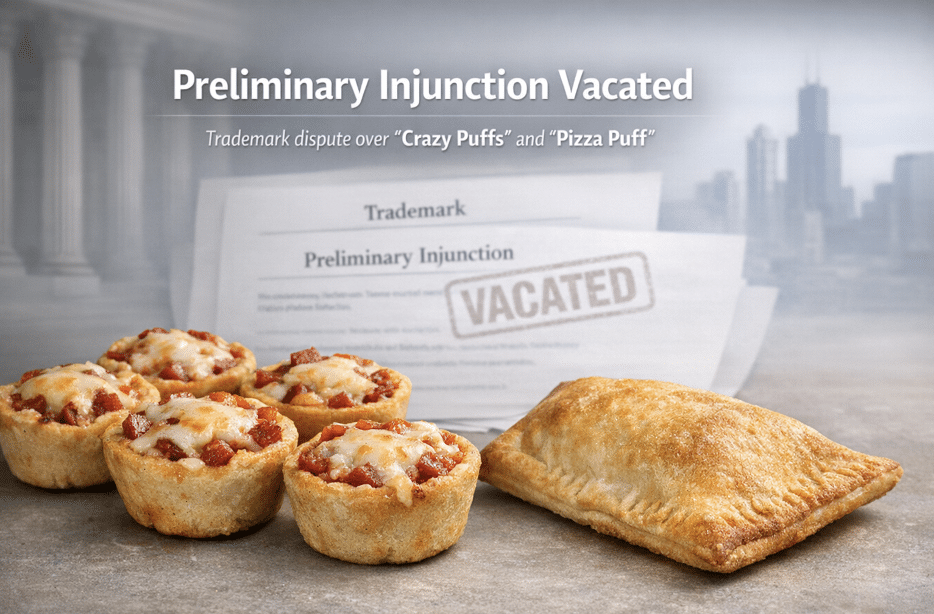
Case: Illinois Tamale Company, Inc. d/b/a Iltaco v. LC Trademarks, Inc. and Little Caesar Enterprises, Inc., Nos. 24-3317, 25-1072, 25-1076 & 25-1112 (7th Cir. Jan. 16, 2026). The Seventh Circuit affirmed the denial of preliminary injunctive relief as to “Crazy Puffs” and “Puff,” and reversed the injunction as to “Pizza Puff.”
In a notable Seventh Circuit trademark decision, the court reversed the preliminary injunction as to “Pizza Puff” and affirmed the denial of injunctive relief as to “Crazy Puffs” and “Puff.” The opinion addresses several recurring trademark law issues: whether a registered term may still be challenged as generic, how the Lanham Act’s primary significance test applies at the preliminary injunction stage, how descriptive fair use can shape the analysis, and how courts assess likelihood of confusion based on the mark as a whole. For brand owners, trademark litigators, and in-house counsel, the decision is a useful reminder that federal registration strengthens a mark but does not displace consumer perception evidence.
Key takeaways
- The Seventh Circuit held that the district court applied the wrong framework in assessing whether “Pizza Puff” remained protectable.
- The opinion underscores that the Lanham Act’s primary significance test governs genericness, even when a mark is federally registered.
- The court also treated descriptive fair use and the overall commercial impression of the marks as central to the preliminary injunction analysis.
- For brand owners, the case is a practical warning against overreliance on registration when a product name tracks the common name of the goods.
Little Caesars launched “Crazy Puffs” in March 2024. The Seventh Circuit described the product as small baked dough cups filled with pizza ingredients and topped with cheese. Little Caesars also has a long-running line of “Crazy” branded products and owns multiple federal registrations for “Crazy” marks, as well as a registration for “Crazy Puffs.”
During the U.S. Patent and Trademark Office review of “Crazy Puffs,” an examining attorney reviewed existing and pending marks and did not identify a likely conflict with earlier registrations, including Iltaco’s “Puff” marks.
Iltaco sent Little Caesars a cease-and-desist letter in April 2024. Iltaco then filed suit in June 2024 seeking a preliminary injunction, an early court order intended to preserve the status quo while the case is litigated.
Seventh Circuit trademark ruling: what the court held on the preliminary injunction
On appeal from the preliminary injunction ruling, the Seventh Circuit declined to stop Little Caesars from using “Crazy Puffs” or “Puffs.” The court also vacated the portion of the injunction that barred Little Caesars from using “Pizza Puffs” in advertising, allowing that terminology to return while the case continues in the district court.
Because the dispute was at the preliminary injunction stage, the focus was not on final liability. Instead, the question was whether Iltaco showed a strong likelihood of success and a risk of harm that warranted temporary restrictions on Little Caesars’ advertising.
Trademark analysis: genericness, descriptive fair use, and likelihood of confusion
The court’s analysis turned on two recurring trademark issues: whether a term functions as a protectable mark at all, and whether consumers are likely to be confused by a similar-sounding name used by someone else. In doctrinal terms, the opinion sits at the intersection of genericness, descriptive fair use, and likelihood of confusion under the Lanham Act.
First, the Seventh Circuit reviewed where “pizza puff” and “puff” fit on the trademark distinctiveness spectrum. At the bottom are generic terms, which name a type of product and cannot serve as trademarks. Descriptive terms can be protected only if consumers associate the term with a single source (often called secondary meaning). Suggestive, arbitrary, and fanciful marks are generally easier to protect.
The key takeaway for business readers is that federal registration helps, but it does not end the analysis. Even an “incontestable” registration can be challenged if the public primarily understands the term as a generic name for the product category.
To decide whether a term is generic, courts look to the term’s “primary significance” to consumers. Put simply, the question is whether consumers mainly hear the term as the name of a type of food, rather than as a brand.
Evidence can include consumer surveys, dictionary definitions, media references, and how the term is used by customers and competitors in the marketplace.
The district court initially enjoined Little Caesars from using “Pizza Puff” in advertising. On appeal, the Seventh Circuit concluded that the record at this stage did not support that restriction.
Little Caesars argued that “pizza puff” is generic and supported that position with survey and reference evidence.
A consumer survey was central. It reported that 83.3% of respondents viewed “pizza puff” as a generic term for a dough-and-pizza-ingredient-filled food, while 12.7% viewed it as a brand name.
The district court viewed the survey as “not conclusive,” relying in part on authority addressing confusion analysis. The Seventh Circuit drew a distinction between confusion and genericness. For genericness, the question is the term’s primary meaning to the public, and the court stated that this “requires far more than ten percent.”
The court also noted reference-style definitions using “pizza puff” as a category label, such as “a dough pouch filled with … pizza sauce … and usually deep fried.”
Separately, Iltaco sought to restrict Little Caesars’ use of “Crazy Puffs” and “Puffs.” On that issue, both courts concluded Iltaco had not shown a sufficient likelihood of consumer confusion at this stage.
The Seventh Circuit reiterated that the likelihood of confusion is assessed based on the overall commercial impression of the marks, meaning the mark “as a whole,” not by isolating a shared word like “puff.”
Practical implications for trademark enforcement, clearance, and product naming
- Evaluate genericness risk early. If a proposed product name tracks the common name of the goods, assess whether the term is generic or merely descriptive before investing in launch and enforcement strategy.
- Do not overread registration. Federal registration, including a mature registration, does not eliminate challenges based on genericness, primary significance, or fair use.
- Use survey evidence carefully. At the preliminary injunction stage, survey design and consumer-perception evidence may materially affect whether a court views a term as protectable.
- Analyze the full commercial impression. Likelihood of confusion turns on the mark as a whole, not simply the presence of one shared term in competing product names.
- Build evidence of source significance. If a client adopts a descriptive term, consistent branding, marketplace recognition, and disciplined usage may become critical in later enforcement.
FAQ: key questions about the Seventh Circuit’s Pizza Puff trademark ruling
Can a federally registered trademark still be challenged as generic?
Yes. The Seventh Circuit emphasized that even a registered mark can be vulnerable if the term’s primary significance to consumers is the name of a product category rather than a source identifier. That issue can arise even when the registration is longstanding.
How do courts evaluate whether two product names are confusingly similar?
Courts do not usually isolate a single shared word. Instead, they evaluate the overall commercial impression of the marks, including the full name, surrounding branding, packaging, and marketplace context.
What should companies do before launching a descriptive product name?
They should assess whether the name may be seen as generic or merely descriptive, clear the full branding presentation rather than just one word, and build evidence that consumers associate the term with a single source if the branding strategy depends on a descriptive phrase.
The broader lesson is straightforward. In trademark disputes over product names, courts will continue to focus on how consumers understand the term in the marketplace, not simply on the existence of a registration certificate. For businesses naming new products, and for counsel evaluating enforcement positions, this decision is a strong reminder to test protectability and litigation risk early.