Obviousness Win: Federal Circuit Affirms Glucose Sensor Claims Unpatentable
The Federal Circuit (CAFC) affirmed a Patent Trial and Appeal Board (PTAB or Board) ruling that claims of DexCom, Inc.’s patent for implantable glucose sensors were unpatentable as obvious.
As the court explained,
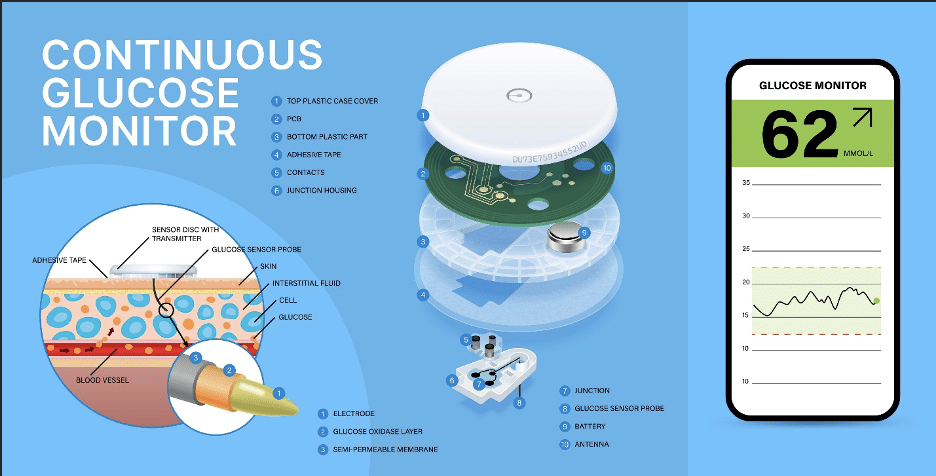
This appeal involves implantable glucose sensors used to monitor a patient’s blood glucose levels. DexCom’s ’193 patent discloses one such sensor, a “transcutaneous continuous glucose sensor system.” … “Transcutaneous” refers to the fact that the sensor is implanted partially below the patient’s skin.
One problem with other implanted glucose sensors was that they tended to lose their function over time due to the body’s local inflammatory response to the implant, known as foreign body response (“FBR”). The’193 patent sought to address the adverse effects of FBR.
The sensor disclosed in the ’193 patent is “amperometric.” This means it uses electrodes to measure glucose levels based on changes in electrical current.
The court noted that
One mechanism of addressing the negative effects of FBR is a sensor configuration that makes use of the barrier cell disruptive layer that promotes tissue in-growth adjacent to the biosensor….. Different sensors may use two or three electrodes in different structural arrangements.
In this case, representative Claim 1 of the ’193 patent claims a sensor with a five-layer stacked arrangement, using three electrode layers separated by two layers of nonconductive material.
After DexCom sued Abbott alleging infringement of the ’193 patent, Abbott petitioned for inter partes review (IPR) of Claims 1–3 and 11–13 of the ’193 patent.
Abbott asserted that the challenged claims would have been obvious to a skilled artisan over prior art reference U.S. Patent Application Publication No. 2005/0215871 (“Feldman”).
Feldman discloses various blood glucose sensors that “may be placed internally, transcutaneously, or externally, relative to a body.”
Feldman’s Figure 4A depicts a three-electrode sensor. Feldman’s Figure 2A shows a “two-electrode amperometric glucose sensor” with the electrode layers separated by a plastic substrate.
Abbott argued that a skilled artisan “would have understood from the depictions in FIGS. 4A and 4B that the three conductive layers associated with the electrodes are located overtop each other in a stacked fashion….”
Abbott also argued that it would have been obvious to a skilled artisan to include non-conductive layers between the electrode layers to prevent a short circuit between the electrodes.
The PTAB instituted the IPR and issued a final decision holding the challenged claims unpatentable as obvious in view of Feldman.
As the USPTO explains,
A patent for a claimed invention may not be obtained, notwithstanding that the claimed invention is not identically disclosed as set forth in section 102, if the differences between the claimed invention and the prior art are such that the claimed invention as a whole would have been obvious before the effective filing date of the claimed invention to a person having ordinary skill in the art to which the claimed invention pertains.
A “person having ordinary skill in the art” is sometimes called a “POSITA” or a “skilled artisan.”
As Cornell Law School explains,
Possible objective indicia of nonobviousness could include commercial success, initial skepticism regarding the invention, and demonstrated failure of others to solve a long-standing problem.
As the European Patent Office explained,
The term "obvious" means that which does not go beyond the normal progress of technology but merely follows plainly or logically from the prior art, i.e., something which does not involve the exercise of any skill or ability beyond that to be expected of the person skilled in the art. In considering inventive step, as distinct from novelty…, it is fair to construe any published document in the light of knowledge up to and including the day before the filing or priority date valid for the claimed invention and to have regard to all the knowledge generally available to the person skilled in the art up to and including that day.
In this case, the PTAB concluded that
“Feldman’s Figures 4A–B would have been understood and interpreted by a person of ordinary skill in the art as encompassing” the claimed five-layer arrangement of stacked electrodes and non-conductive layers.
Abbot appealed.
However, Abbott withdrew from this appeal before oral argument. Pursuant to 35 U.S.C. § 143, the Acting Director of the USPTO exercised her right to intervene in the appeal.
As Reuters explained, Abbot and DexCom settled all patent disputes between them in December 2024. As part of the settlement, Abbott also granted DexCom a worldwide license to certain patents and applications.
On appeal, the Federal Circuit noted that
Obviousness is a question of law based on underlying findings of fact. Univ. of Strathclyde v. Clear-Vu Lighting, 17 F.4th 155, 160 (Fed. Cir. 2021). Underlying facts include “(1) the scope and content of the prior art; (2) the differences between the claims and the prior art; (3) the level of ordinary skill in the pertinent art; and (4) any secondary considerations of non-obviousness.”
The court explained that precedents require the Board to consider Feldman “not only for what it expressly teaches, but also for what it fairly suggests” to a skilled artisan.
The Board credited expert testimony that a skilled artisan would have understood Feldman’s Figure 4A as encompassing three electrode layers “located overtop each other in a stacked fashion.”
Consistent with this standard, the court said, the Board focused its inquiry on what Feldman would teach or suggest to a person of ordinary skill in the art, rather than limiting itself to what Feldman literally says or shows.
“To do otherwise,” said the court, “would have been an error.”
The court said that DexCom never explained how the Board erred but insisted that the Board should have interpreted Feldman differently.
The court noted that the PTAB relied on the evidence before it, including expert testimony, and found that a skilled artisan would have interpreted Feldman as encompassing the stacked electrode arrangement.
The court thus concluded that
the Board relied on substantial evidence in determining that a skilled artisan would have understood Feldman as encompassing the claimed five-layer arrangement of stacked electrode layers and non-conductive layers.
The court thus affirmed the PTAB’s decision holding that Claims 1–3 and 11–13 of the ’193 patent are unpatentable as obvious.