Federal Circuit Upholds ITC Exclusion Order Against Certain Apple Watch Imports in Masimo Patent Dispute

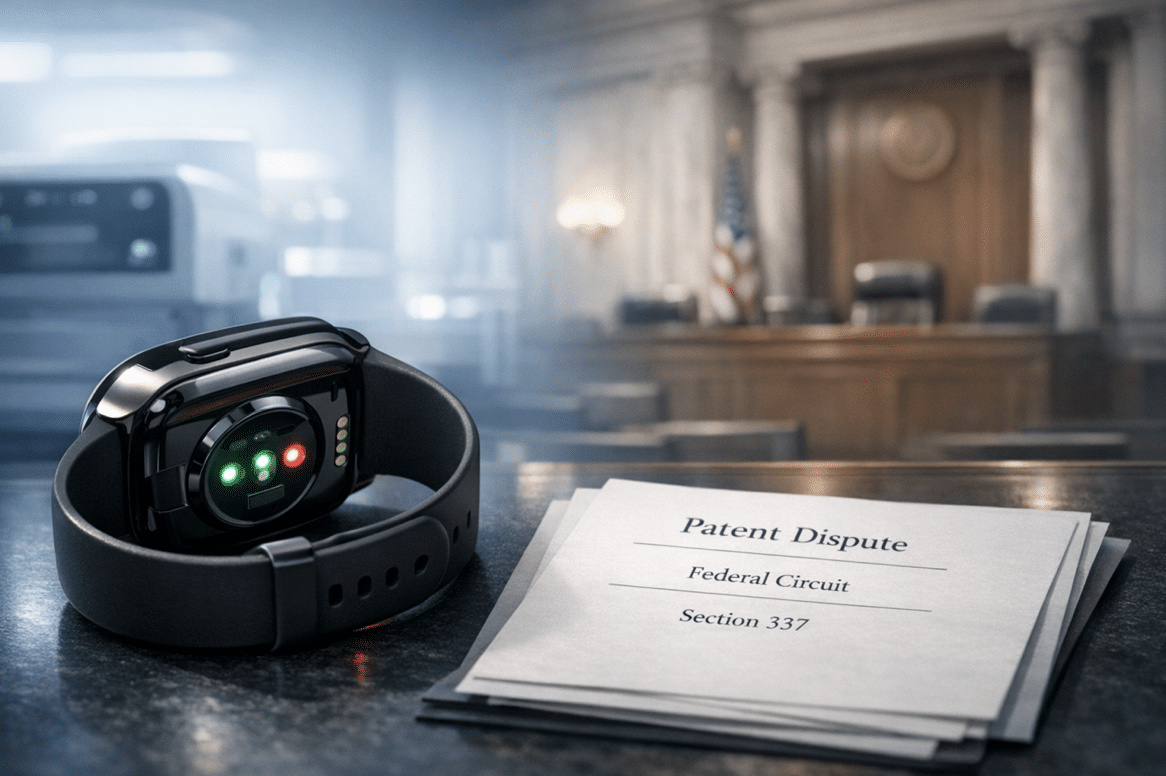
The U.S. Court of Appeals for the Federal Circuit has affirmed an International Trade Commission determination barring imports of certain Apple Watch models with blood-oxygen functionality. The decision leaves in place a limited exclusion order under Section 337 of the Tariff Act and confirms that Masimo established infringement, a qualifying domestic industry, and the validity of the asserted claims.
For companies that design, import, or commercialize connected medical or wearable products, the ruling is a meaningful reminder that the ITC remains a powerful forum for patent disputes involving imported goods. It also clarifies that prototype and development-stage evidence may support the domestic-industry requirement when tied to substantial U.S. investment and patent-practicing activity.
Background: Apple Watch blood-oxygen patents and the ITC case
In September 2020, Apple launched the Apple Watch Series 6 with a blood-oxygen feature. In June 2021, Masimo and Cercacor filed a complaint at the ITC, alleging that Apple imported and sold watches that infringed patents covering wearable blood-oxygen measurement technology.
Masimo is a medical technology company known for noninvasive monitoring technologies. The patents at issue, U.S. Patent Nos. 10,912,502 and 10,945,648, generally concern user-worn devices that use light emitters and photodetectors to estimate physiological metrics through tissue, including blood oxygen saturation.
After an ITC investigation, the Commission found a violation of Section 337. Section 337 is the federal trade statute that allows the ITC to block imports tied to unfair acts, including patent infringement. The Commission issued a limited exclusion order, which bars importation of infringing products into the United States.
What the Federal Circuit decided
The Federal Circuit affirmed the Commission on each of the principal issues raised on appeal. Applying the Administrative Procedure Act’s substantial-evidence standard, the court concluded that the record supported the ITC’s findings on domestic industry, infringement, validity, and prosecution laches, and that none of Apple’s arguments warranted reversal.
- Infringement affirmed: the ITC could find that Apple’s accused Apple Watch models met the asserted Masimo claim limitations.
- Domestic industry affirmed: Masimo’s prototype and development evidence could support the required U.S. industry showing.
- Validity rulings affirmed: Apple did not overturn the ITC’s rejection of its obviousness and written-description challenges.
- Prosecution laches rejected: the record did not establish the type of unreasonable delay needed to make the patents unenforceable.
Why the Federal Circuit affirmed the ITC
1. Prototype evidence can satisfy the domestic-industry requirement. Apple argued that Masimo’s domestic-industry showing was too preliminary because the relevant products were still under development. The Federal Circuit disagreed. It held that the Commission could rely on prototype devices, testing, witness testimony, and related evidence to find both a patent-practicing article and substantial U.S. investment. That aspect of the opinion may prove significant for companies whose products move through iterative development cycles before full commercial launch.
2. The validity challenges did not gain traction on appeal. Apple contended that the asserted claims were obvious and inadequately supported by the specification. The court, however, found no basis to disturb the ITC’s conclusions. As a result, the asserted claims remained enforceable for purposes of the exclusion order.
3. The prosecution-laches defense fell short. Prosecution laches is an equitable defense based on unreasonable and unexplained delay in pursuing patent claims. Apple argued that Masimo waited too long to present certain claims. The Federal Circuit agreed with the ITC that the record did not show the type of delay required to render the patents unenforceable.
4. The infringement findings remained intact. The court also upheld the Commission’s conclusion that Apple’s accused watch designs met the asserted claim limitations. That determination preserved the exclusion order as to the products before the agency.
What companies should do now after an ITC exclusion order
The decision has practical significance well beyond the wearable-device market. First, it underscores the continued force of Section 337 as a patent enforcement mechanism because the ITC can exclude imported products from the U.S. market, not merely award damages after the fact. Second, it confirms that pre-commercial products may support a domestic-industry case when the evidentiary record shows genuine U.S. engineering, research, and development tied to the asserted patents.
The opinion also highlights the importance of parallel redesign efforts. Even where an exclusion order is affirmed, a respondent may still seek to commercialize a modified product that falls outside the order. In practice, appellate strategy, customs strategy, and product redesign often need to proceed together.
- Assess import exposure early and map which products, components, and software features may be implicated.
- Build a technical record that supports noninfringement, invalidity, and any design-around position.
- For patent owners, tie U.S. investment to concrete patent-practicing articles, even if development is iterative.
- Coordinate ITC strategy, customs strategy, and redesign strategy from the outset.
For product companies, the broader lesson is straightforward: an appeal is not the only path to a business solution, and an affirmed exclusion order does not necessarily end the commercial analysis. In disputes involving integrated hardware and software systems, redesign work may materially affect the ultimate business outcome.