Circuit Court Vacates $1.5 Million Award in Fake Law Firm Trademark Case

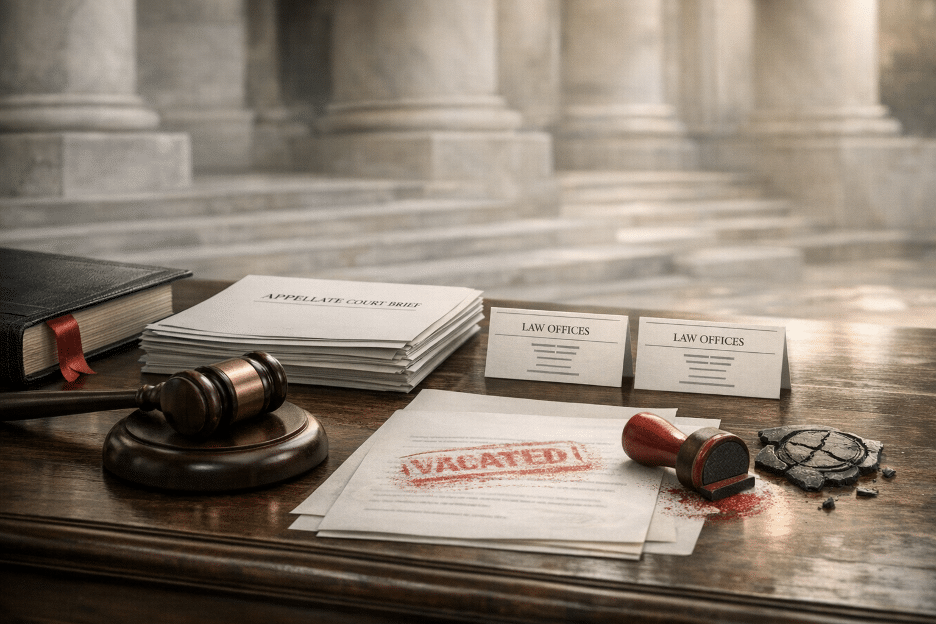
The Fifth Circuit has vacated a $1.5 million damages award in a case involving a fake law firm trademark.
The case is Lewis Brisbois Bisgaard & Smith LLP v. Bitgood.
Lewis Brisbois Bisgaard & Smith, LLP (LBBS) is a Texas law firm.
LBBS sued Michael Joseph Bitgood a/k/a “Michael Easton,” Susan C. Norman, Bradley B. Beers, and the Texas entity known as “Lewis Brisbois Bisgaard & Smith, LLP,” (collectively, Defendants) alleging
- trademark infringement under § 32 of the Lanham Act (15 U.S.C. § 1114);
- unfair competition under § 42 of the Lanham Act (15 U.S.C. § 1125) and Texas common law;
- common-law fraud; and
- civil conspiracy to infringe upon trademarks and name, and to commit fraud.
As the court explained,
This saga began in the Texas state court when Bitgood and another tenant, represented by attorney Norman, sued a corporate landlord, represented by LBBS. During those proceedings, Bitgood and Norman discovered that LBBS’s foreign limited liability partnership registration with the State of Texas had lapsed. They quickly registered a new entity under the name “Lewis Brisbois Bisgaard & Smith, LLP” with the Texas Secretary of State. They then enlisted Beers, also an attorney, to prepare and file an assumed name certificate with the state under the same name…
After creating this fake entity, Bitgood and Norman amended the state-court petition to include it as a party. They then filed a motion under Texas Rule of Civil Procedure 12 challenging the real LBBS’s authority to represent the landlord. The court granted the motion, ruling that LBBS lacked such authority. In response, LBBS sent a cease-and-desist letter to Norman and Bitgood, who refused to comply and instead continued to proffer filings in state court under LBBS’s letterhead.
The Defendants stated in depositions and to the press that they “purposefully took LBBS’s name, used it in correspondence and court filings, printed fake LBBS business cards, and taunted the real LBBS with their appropriation of its marks.”
The district court granted LBBS summary judgment on its claims and entered a permanent injunction, statutory damages, and attorneys' fees.
The district court awarded $1 million in damages against Bitgood, $500,000 against Norman, and $10,000 against Beers.
Bitgood, Norman, and Beers each appealed separately.
Beers argued that, because he only prepared and filed the assumed name certificate with the Secretary of State, he could not have used LBBS marks in commerce.
Under the Lanham Act, which governs trademarks,
(1)Any person who shall, without the consent of the registrant—
(a) use in commerce any reproduction, counterfeit, copy, or colorable imitation of a registered mark in connection with the sale, offering for sale, distribution, or advertising of any goods or services on or in connection with which such use is likely to cause confusion, or to cause mistake, or to deceive; or
(b) reproduce, counterfeit, copy, or colorably imitate a registered mark and apply such reproduction, counterfeit, copy, or colorable imitation to labels, signs, prints, packages, wrappers, receptacles or advertisements intended to be used in commerce upon or in connection with the sale, offering for sale, distribution, or advertising of goods or services on or in connection with which such use is likely to cause confusion, or to cause mistake, or to deceive…
…is liable to the trademark registrant (i.e., the rightful owner of the trademark) for the remedies prescribed by the statute.
Under another section of the Lanham Act,
(1) Any person who, on or in connection with any goods or services, or any container for goods, uses in commerce any word, term, name, symbol, or device, or any combination thereof, or any false designation of origin, false or misleading description of fact, or false or misleading representation of fact, which—
(A) is likely to cause confusion, or to cause a mistake, or to deceive as to the affiliation, connection, or association of such person with another person, or as to the origin, sponsorship, or approval of their goods, services, or commercial activities by another person, or
(B) in commercial advertising or promotion, misrepresents the nature, characteristics, qualities, or geographic origin of their own or another person’s goods, services, or commercial activities, shall be liable in a civil action by any person who believes that he or she is or is likely to be damaged by such act.
See 15 U.S.C. § 1114, 1125(a).
On appeal from the preliminary injunction, the circuit court had held that “[c]ommon sense, clear concessions by Federal Defendants, and case law establish that [Defendants’] infringing uses were ‘uses in commerce.’”
The court cited a decision from another circuit holding that conduct such as forming a corporation and making public communications was sufficient to meet this element of trademark infringement.
The Defendants also argued the damages award lacked a proper basis because LBBS’s trademark had lapsed in 2020 and was not reregistered until 2022, the time period during which Defendants engaged in their putative infringement.
The court agreed that putative infringement of an unregistered mark cannot support a damages award under 15 U.S.C. § 1114(1)(a).
However, said the circuit court,
The district court did not explain the basis for the damages award under the relevant statutes. As a result, we lack the necessary findings and reasoning to effectively review its damages conclusion—and specifically, whether damages would be justified for Defendants’ putative infringement of LBBS’s other registered marks. Accordingly, we vacate the award of statutory damages as to each Defendant and remand for further consideration of Defendants’ liability under § 1114(1)(a).
Also, on remand, the circuit court suggested that the district court consider whether the Seventh Amendment to the US Constitution requires submission of the damages question to a jury.
The circuit court noted that although LBBS and Defendants both demanded a jury trial, the district court awarded damages itself. On appeal, Bitgood and Norman argued this violated the Seventh Amendment.
The circuit court also vacated the fee award and remanded the fee issue to the district court for reconsideration.