Federal Circuit Affirms Rejection of VOIP Patent Claims as Obvious

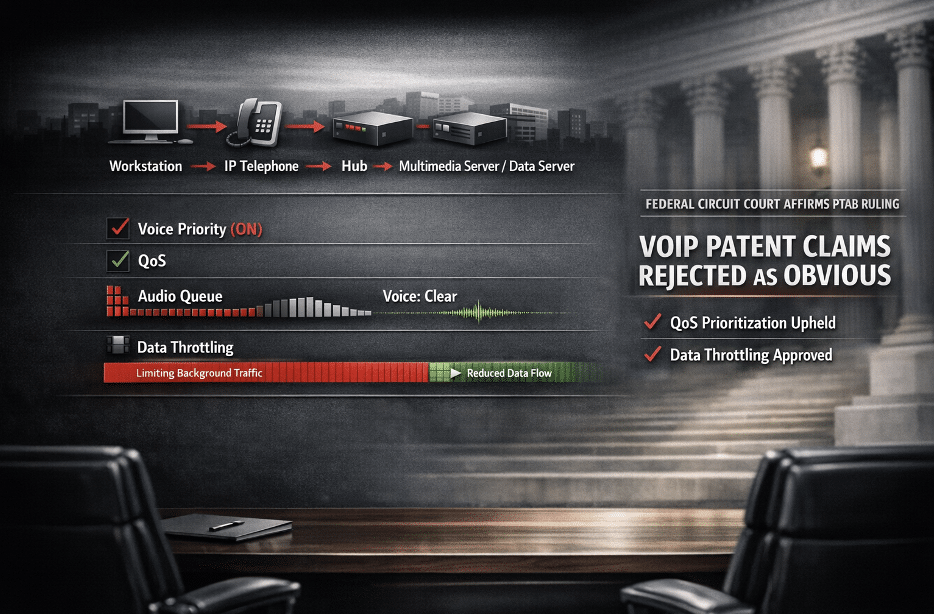
The Federal Circuit has affirmed a ruling by the Patent Trial and Appeal Board (PTAB or Board) that the US Patent and Trademark Office (USPTO) correctly found claims in an Estech Systems IP LLC patent covering quality improvements to voice over internet protocol (VOIP) telephone systems to be obvious and unpatentable.
The challenged claims relate to methods for improving the quality of service in VoIP telephone systems by prioritizing audio information. The methods are intended “to give the multimedia traffic priority during peak traffic loads,” thus “providing increased multimedia traffic bandwidth when needed.”
Claim 29, which is representative of most of the issues relevant to the appeal, recites:
In an information handling system comprising a hub, a multimedia server (“multimedia server”) coupled to the hub, a telephone coupled to the hub, a workstation coupled to the hub through the telephone, and a data server coupled to the hub, a method comprising the steps of:
transferring data from the workstation to the telephone, wherein the data sent from the workstation is addressed for transmission to the data server;
communicating audio information between the telephone and the multimedia server;
and sufficiently throttling the data sent from the workstation to the telephone to increase a rate of transfer of the audio information during the communicating step, wherein the throttling step further comprises the step of monitoring an amount of the audio information being received by the telephone from the multimedia server.
(Emphasis added by court.)
In 2021, Cisco Systems, Inc. requested an ex parte reexamination of claims 29–41 of the patent.
The examiner granted the request for ex parte reexamination, determining that the combination of prior art references Chiu and Bustini raised a substantial new question of patentability affecting these claims.
The court noted that Chiu discloses a system that includes almost all of the claimed features, which may be used in conjunction with “collision avoidance mechanisms well known in the networking arts.”
Chiu, however, does not itself disclose throttling data, which is disclosed by Bustini.
The examiner issued a final rejection of claims 29–41 as unpatentable as obvious over Chiu and Bustini in 2022.
Estech appealed the examiner’s decision to the Board, which in 2024 affirmed the examiner’s rejection of each challenged claim.
First, Estech contended that the Board erred by incorrectly construing the claim term “telephone,” which appears in claims 29–41, and, under the correct construction, the required features of the “telephone” are not disclosed in Chiu.
Under Estech’s proposed construction, noted the court, the claimed “telephone” must have a dialing interface, a speaker, and a microphone.
However, the patent itself defines an “IP telephone” or “telephony device” as “any apparatus, device, system, etc., that can communicate multimedia traffic using IP telephony technology.”
Since the patent specification “is the single best guide to the meaning of a disputed term,” said the court, citing Phillips v. AWH Corp., 415 F.3d 1303, 1315 (Fed. Cir. 2005), the claimed “telephone” may not be construed to require elements not found in the specification’s own definition.
In any case, the court found no error in the Board’s finding that Chiu disclosed a telephone with a dialing interface, speaker, and microphone.
Second, the parties agreed that the “telephone” is a separate device from the “workstation.”
Estech contended that Chiu’s telephone is not separate from its computer, which the Board mapped to the claimed “workstation.” The Board found that one embodiment of Chiu’s “IP telephone peripheral” is “a hardware-based telephony apparatus” that “is a standalone IP telephone client device,” which is separate from the computer.
The court thus saw no error in the Board’s conclusion that Chiu therefore discloses the claimed “telephone,” which is separate from the claimed “workstation.”
Third, Estech argued that the proposed combination of prior art did not disclose the limitation of claims 29 through 35 that requires “sufficiently throttling the data sent from the workstation to the telephone to increase the rate of transfer of the audio information.”
Estech argued that this was because the claimed throttling must be based on monitoring the amount of audio information being received by and destined for the telephone.
However, said the court, the patent claims do not require that the claimed throttling is “based on” this audio information.
Said the court,
So long as a method both “sufficiently throttl[es] data sent from the workstation to the telephone to increase a rate of transfer of the audio information during the communicating step” and “monitor[s] an amount of audio information being received by the telephone from the multimedia server,” the “sufficiently throttling” limitation is satisfied.
By contrast, said the court, other claims of the patent expressly include limitations that require throttling based on monitoring specific types of data.
Estech conceded at oral argument that Bustini discloses monitoring audio information in a queue.
Also, the Board agreed with the patent examiner’s finding that “Bustini monitors an amount of audio data being received to assign it higher priority . . . . As a result, the audio data rate is increased over what the audio data rate would have been in the presence of congested, bursty traffic.”
Thus, the court found no error in the Board’s conclusion that the proposed combination discloses the “sufficiently throttling” limitation.
Fourth, Estech argued that the Board incorrectly found that with respect to the “sufficiently throttling” limitation, ordinarily skilled artisans would not have a motivation to combine Chiu and Bustini or a reasonable expectation of success of combining the two prior art references, and that such a combination would violate Chiu’s principle of operation.
The court found that Estech’s “motivation to combine” arguments attacked a hypothetical bodily incorporation of Bustini into Chiu – i.e., the components, transmitters, and receivers.
However, said the court,
the test for obviousness “is what the combined teachings of the references would have suggested to those of ordinary skill in the art,” not “whether the features of a secondary reference may be bodily incorporated into the structure of the primary reference.”
The court noted that the Board found that “[b]oth Chiu and Bustini recognize the importance of avoiding delays for voice transmissions.”
Chiu discloses that its system could employ traffic-control mechanisms “well known in the networking arts,” and Bustini discloses such a “well known congestion control mechanism prioritizing voice [that] would have been readily apparent to a skilled artisan at the time of the invention,” said the court.
Thus, the court found no error in the Board’s underlying factual findings regarding motivation to combine or a reasonable expectation of success.
The court also rejected Estech’s remaining arguments and thus affirmed.